
Walking down Barkhor Street in Lhasa at dawn, you’ll see it immediately: A group of people moving in one direction flawlessly, spinning their handheld prayer wheels, mumbling under their breath, and some of them even pause every few steps and bow deeply in complete prostration. They aren’t just sightseeing, but performing kora. Understanding what is kora in Tibet is one of the key steps to experiencing Tibetan culture beyond scenery.
What Is Kora in Tibet? What Does Kora Mean in Tibetan Buddhism?
To understand the practice, one must first understand kora, which is a fundamental principle of Tibetan Buddhism. Kora is a Tibetan word for circumambulation, the act of walking around sacred object, building, or natural landmark. It is believed that the practice is performed both in Tibetan Buddhism and the pre-Buddhist Bon religion. The Tibetan uses the term nekor to describe the broader pilgrimage journey itself, while kora refers to the circuit.
The concept of né, which means a place or an object that is considered sacred, is based on a belief that a person who approaches it with the right thoughts will benefit from the experience subjectively. Sacred objects or places may include stupas with relics, monasteries, natural formations, and lakes. The more followers go, the more sacred a place is.
Why Tibetan Buddhists Circumambulate Sacred Sites?
Most tourists wonder why Tibetan Buddhists circumambulate sacred sites; it is important to note that there is a particular spiritual significance to this behavior.
It is done to accumulate merit, removing negative karma from past actions and thoughts, and to develop bodhicitta throughout the practice. The intentions of walking around sacred places in religious traditions are considered a chance to make offerings and chant Matras as they go. They aim to change the self-centered mindset that brings suffering to themselves and others.
Many Buddhist pilgrims view the kora as a chance to both physically and spiritually endure hardships. They believe that the effort put into this walk will help them burn away their impurities, delusions, and old patterns of thought and action. This is why it is not uncommon to see people making the kora circuits throughout Tibet daily, as opposed to only during major holidays. It is one of the ways people demonstrate their devotion, alongside mantra chanting and meditation.
How a Kora Is Performed
There is a particular etiquette to be observed while circumambulating. Followers of Tibetan Buddhism always walk in a clockwise direction around a sacred object, keeping the object of devotion on their right side. Bon adherents, by contrast, walk the other way around, which is a tradition a pilgrim follows.
In addition to what has already been noted, you will typically see a few recurring elements:
• Mani stones: rocks and stone plates with the mantra Om Mani Padme Hum inscribed on them may be found along the route. In addition to the mani stones, one can find other objects made by the locals in which one can see a prayerful intention, such as mantras, placed on them when circumambulating.
• prayer wheel: while circumambulating, you can also spin wheels with prayers. Turning a prayer wheel counts as saying the mantra carved on it.
• Prostration: For the most devout of the pilgrims, walking is replaced by an even more rigorous movement: a prostration of the body. They kneel and stretch their bodies on the ground in such a manner as to touch the earth at their forehead, then rise and walk to where their forehead had touched the earth, and repeat this process of touching and walking. The most zealous among them do this for every step, for an entire journey, which would take the ordinary walker but a fraction of the time to finish.
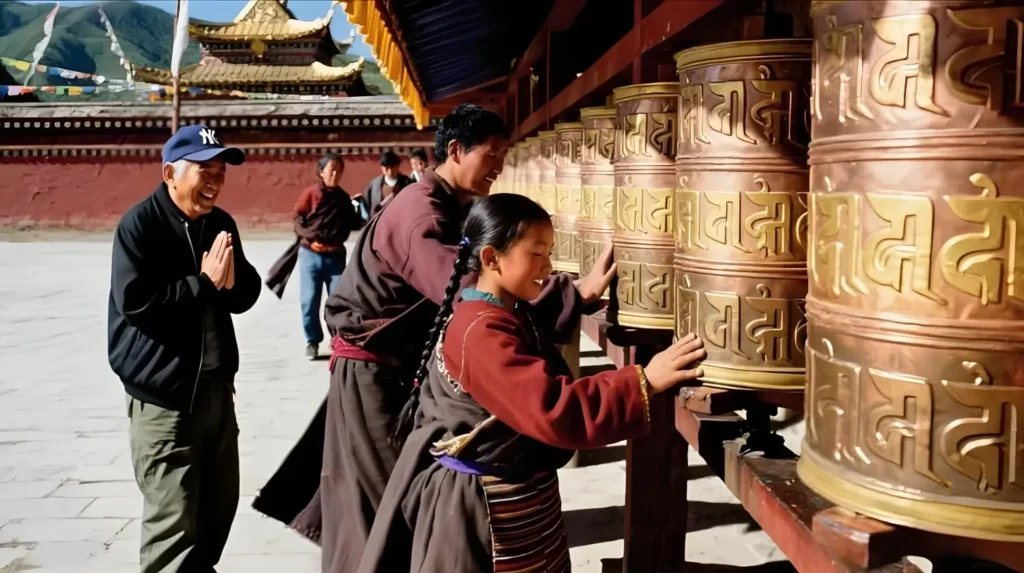
Group of Tibetan Performing Kora
The Most Famous Koras in Tibet
Experiencing the Barkhor Kora in Lhasa
The Barkhor kora goes around the Jokhang Temple in the center of Lhasa and is the easiest to access for tourists, as it winds through the old quarter of the city and is walked by residents on a daily basis – often multiple times a day. A walk around the Barkhor Kora gives insight into the life and faith of the local people.
The other Tibetan circuit walks around Lhasa that are popular among tourists are:
• The Lingkor Kora: The biggest traditional circuit around Lhasa, which goes up to the old outer walls of the city and is significantly longer than the Barkhor Kora.
• The Tsekhor Kora: A three km long walk around the base of Marpo Ri, which takes roughly 45 minutes to complete and is also a frequent choice among those visiting the Potala Palace – as well as a popular circuit to undertake for those visiting Lhasa with a religious purpose.
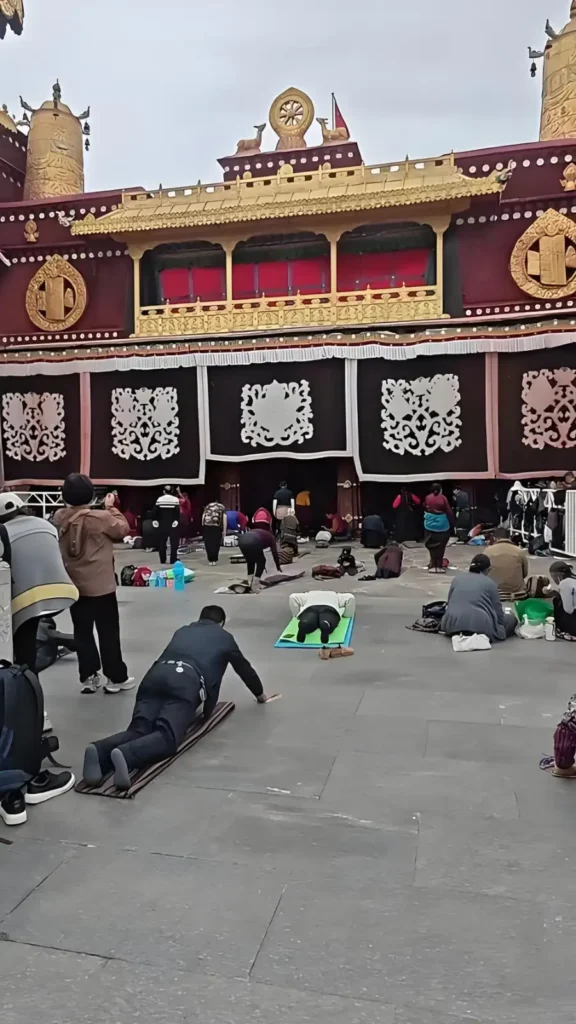
Barkhor Kora in Lhasa
Trekking the High-Altitude Mount Kailash Kora
The Mount Kailash kora pilgrimage is truly something else. Regarded as the most sacred mountain in Tibet by the followers of Buddhism, Hinduism, Jainism, and Bon, the circuit around the holy peak is a demanding multi-day hike up and over the 5,630-meter Dolma La Pass. For many, a journey around Mount Kailash kora is a deeply spiritual endeavor that helps to wash away a lifetime of sins, and so every year thousands of pilgrims arrive in this remote region of western Tibet.
Can Non-Buddhist Travelers Join a Kora?
Yes. Kora routes are open, public roads, not closed or secret, so it’s fine for anybody to walk along them with respect for the local traditions. It’s not necessary to be a Buddhist to make a pilgrimage, although one may certainly do so if they wish. There’s no need to memorize any particular mantras, or to understand the philosophical teachings of Buddhism, and it is useful to remember to treat the road and its pilgrims with the same respect you would anywhere else, and to remember that the locals are not putting on a show for your benefit, but actually practicing their religion.
Kora Etiquette for Visitors
• Move clockwise, keeping sacred objects on your right.
• Wear modest clothing, especially at monasteries and temples.
• Ask permission to take a photo of a pilgrim, especially one prostrating.
• Do not step over prayer wheels, mani stones, or other objects left as an offering.
• Talk softly around shrines and to people prostrating.
If you are not familiar with the proper ritual, it is best to observe quietly. Nobody expects you to know what to say or do when it comes to mantras.
Experience Kora as Part of Your Tibet Journey
Whether it’s the short but impressive Barkhor circuit in Lhasa or the high-altitude and extremely challenging trek around Mount Kailash, a pilgrimage on foot is a unique chance to get close to Tibetan Buddhism from the inside and not just from the outside perspective.
A pilgrimage is an amazing experience, but to plan one requires considerable experience. Luckily for you, our local guides can assist in crafting an itinerary that includes all the must-visit koras and other sacred sites linked with the most prominent spiritual figures in Tibetan Buddhism.